

For years, India has pursued aggressive maritime expansion through larger ports, stronger logistics corridors, domestic shipbuilding, and the development of global shipping lines. However, despite these ambitions, the country continued relying heavily on overseas insurance markets for marine coverage during periods of global instability.
The launch of the Bharat Maritime Insurance Pool comes amid escalating tensions in the Middle East, sanctions-related disruptions, and growing fragmentation in global trade routes. These developments have exposed the vulnerability of international shipping channels, where foreign insurers frequently increase premiums sharply or withdraw coverage entirely from high-risk regions such as the Strait of Hormuz.
For India, which imports most of its energy requirements and depends significantly on maritime trade, such disruptions represent a strategic and economic risk. The new insurance mechanism is intended to ensure continuity of shipping operations even during periods of severe geopolitical instability.
The Bharat Maritime Insurance Pool will provide coverage for marine hull and machinery, cargo, protection and indemnity, and war risks for Indian-flagged or India-linked vessels. The mechanism will be administered by General Insurance Corporation of India, while a governing body and underwriting committee will supervise operations and risk management.
The first policy under the new framework has already been issued. The New India Assurance Company provided a Marine Hull and Machinery War Policy to Hoger Offshore and Marine Pvt Ltd, formally operationalising the insurance pool.
The structure of the mechanism has been designed with layered financial safeguards. Claims up to $100 million will be settled through pooled insurance capacity. Claims exceeding that threshold will be supported through the sovereign guarantee after reserves and reinsurance arrangements are exhausted.
The move signals the government’s intention to prevent disruptions in critical maritime activity due to insurance market instability.
India currently owns slightly over 1,500 ships, accounting for barely 1.2 per cent of the global shipping fleet despite being one of the world’s largest trading economies. According to the Investment Information and Credit Rating Agency, India spends nearly $90 billion annually on freight expenses, with most of the amount flowing to foreign shipping companies.
Global shipbuilding dominance remains concentrated in Asia. According to Clarkson Research data cited in a Bloomberg report, Chinese-built ships account for 34.8 per cent of the global fleet currently in operation. South Korea contributes 30.9 per cent, while Japan accounts for 25.8 per cent. The United States, despite being the world’s largest economy, represents only 0.4 per cent of the global fleet.
India is now attempting to position itself among the leading maritime powers by building an integrated ecosystem covering ports, shipyards, logistics corridors, financing systems, shipping lines, and insurance infrastructure.
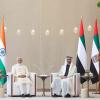
Earlier this week, Japan’s Mitsui OSK Lines, the world’s second-largest ship owner by fleet size, expressed interest in investing in shipbuilding and logistics infrastructure projects in India. Separately, India signed a tripartite memorandum of understanding for a major greenfield shipyard project in Thoothukudi, Tamil Nadu. During Prime Minister Narendra Modi’s visit to the United Arab Emirates on Friday, both countries also signed a memorandum of understanding to establish a Ship Repair Cluster at Vadinar in Gujarat.
Insurance industry experts described the launch of the maritime insurance pool as a decisive development for India’s shipping ambitions.
Gaurav Agarwal, Head of Marine Specialities at Prudent Insurance Brokers, described insurance as the final missing component in India’s maritime strategy. He stated that the Bharat Maritime Insurance Pool, led by General Insurance Corporation of India, could complete India’s emergence as a comprehensive maritime power by strengthening domestic underwriting expertise and reducing dependence on overseas markets for specialised marine insurance.
Marine insurance, particularly war-risk coverage, remains a highly specialised international business dominated by a small number of global players concentrated in markets such as London. During geopolitical crises, countries lacking domestic insurance capacity often face severe pricing shocks or sudden withdrawal of coverage.
Narendra Bharindwal, President of the Insurance Brokers Association of India, called the initiative a timely and progressive step amid rising geopolitical uncertainty and changing trade routes. According to Bharindwal, the insurance pool could deepen India’s underwriting capabilities, improve risk-sharing capacity, and gradually increase domestic retention of maritime risks instead of relying excessively on foreign reinsurers.
However, Bharindwal also cautioned that the long-term sustainability of the mechanism would depend on disciplined underwriting practices, strong governance standards, accurate pricing structures, and professional risk assessment systems.
Marine insurance remains a high-risk sector where a single large maritime accident, oil spill, cyberattack, or war-related incident can trigger massive financial liabilities. Building a resilient domestic maritime insurance ecosystem will therefore require sustained capital strength and advanced technical expertise.
Despite the challenges, India appears determined to pursue strategic independence in maritime trade and shipping infrastructure. The launch of the Bharat Maritime Insurance Pool signals a broader effort to secure India’s long-term economic and geopolitical interests by creating a self-reliant maritime ecosystem capable of withstanding global disruptions.
About The Author










Comment List